Pricing for Freelance Graphic Designers
After making a TikTok post about how much I charge for my branding projects blew up, I received a lot of questions about pricing and it got me thinking about how many designers struggle with it, I know I certainly did!
Pricing can be very tricky because it comes with a lot of existing negative feelings making it difficult to talk openly about. I come from a white, middle-class family (aka lots of privilege), and growing up my family always talked openly about money. Personally, I enjoy talking about money but I also understand that not everyone feels that way. I believe the more we talk about money and are transparent about how much we make in our design businesses the more it benefits the design community as a whole.
A recent article by AIGA titled ‘It’s Time for Graphic Design to Embrace the Radical Potential of Salary Transparency’ talks about the importance of transparency in the design community when it comes to graphic industry salaries. They created an anonymous survey that has almost 3,000 entries of people sharing their years of experience, company size, race, gender, and salary. If you comb through the entries you can see there’s a very wide range.
Looking at how much a designer in a similar job title and experience level to you makes can be helpful to see where you stand, but if you’re a freelance designer you need to charge more than what an in-house designer makes.
When you freelance you have to pay for your own computer, Adobe subscriptions, insurance, CRM tools, website hosting, the list goes on and the expenses add up quickly! When you first start freelancing you can use in-house salaries as a marker but there are many other factors to consider when pricing a design project.
Where to start pricing your design services?
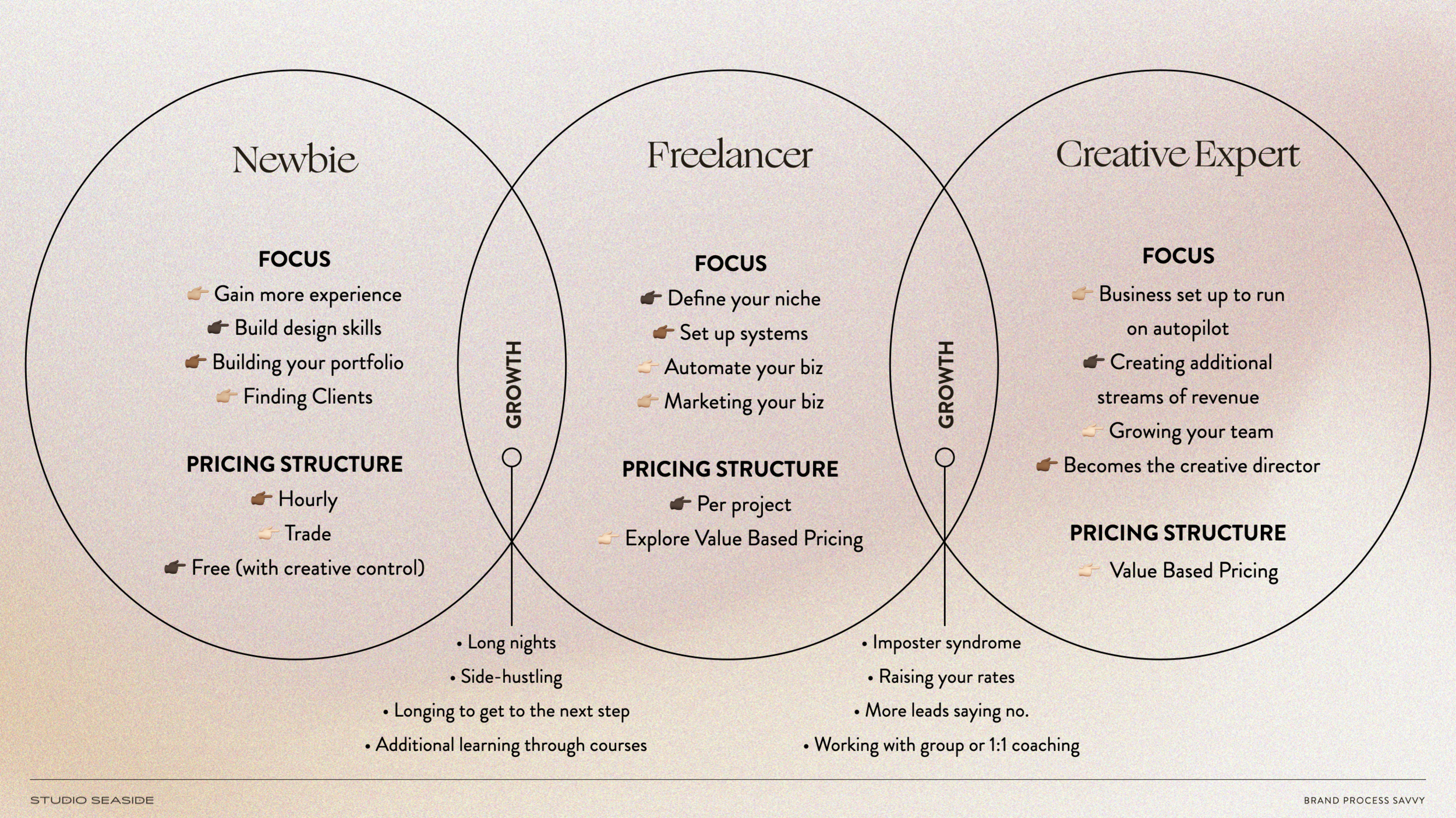
A good place to start when figuring out how much to charge as a freelancer is determining the phase of your design career you’re in. For the sake of this article let’s break the phases into 3.
The Newbie
Whether you’re a new graduate or a self-taught designer, if you have less than a year of real-world design experience you’d be considered a newb. The main focus of your efforts should be put into gaining experience, building your portfolio, and networking with fellow designers. You might even score an in-house position at a studio or company.
If you went to school for design, you learned a lot but you might have graduated realizing there’s a lot still to learn! Continuing your education with online courses is important, the more you narrow in on your design style, specialty and niche you’ll be able to find online courses specifically for your needs.
When it comes to pricing you can start out charging hourly then move into per project quotes as you gain more experience. (Don’t worry, I’ll cover how to work these out below!)
The Freelancer
As you start to gain real-world experience and build your portfolio you might be ready to branch out on your own. You might start with a side-hustle, work late nights trying to get those projects done, or jump into the freelance world with two feet.
Your main focus should be on getting really specific about the types of clients you want to be working with. Setting your business systems up so that repetitive tasks can be automated and creating a marketing strategy that brings you in consistent leads.
As a freelancer, you have enough experience to charge a flat fee per project and can even begin to explore Value-Based Pricing (Don’t worry, I’ll cover more on Value-Based Pricing below!)
The Creative Expert
Once you’ve been at the freelance game for a while, you’ve worked with enough clients to spot red flags a mile away, you’ve got a niche portfolio, testimonials to back it up and your design process is so streamlined you could easily hand it off to another designer to handle.
Your main focus is on setting up your business to run on autopilot, creating additional revenue streams, and outsourcing jobs you no longer want to do (hello bookkeeper!).
As you move into this role, you’re no longer a designer for hire but a creative expert. Clients come to you for your creative opinion and problem-solving skills, for that reason you can charge for projects based on the value that you bring to the client rather than a standard flat fee.
But how much should I charge?
In order to determine how much to charge you need to think about your baseline income. This is the hourly or per project rate that you need to charge in order to be able to be profitable in your business.
This is where the salaries from in-house designers come in handy. If you’re not sure what a fair take-home amount should be for your experience and job title, you can browse what other designers make for reference.
Once you determine what you want your take-home or ‘salary’ to be, you need to factor in your monthly expenses (Computer hardware, Adobe subscriptions, insurance, monthly software subscriptions, website hosting, studio rent, etc). Whip out the pen and paper and pull out your calculator to double-check the numbers!
Desired Monthly Take Home + Expenses = Needed Monthly Revenue
(eg: $8,000/month + $2,000 in expenses = $10,000 Monthly Revenue)
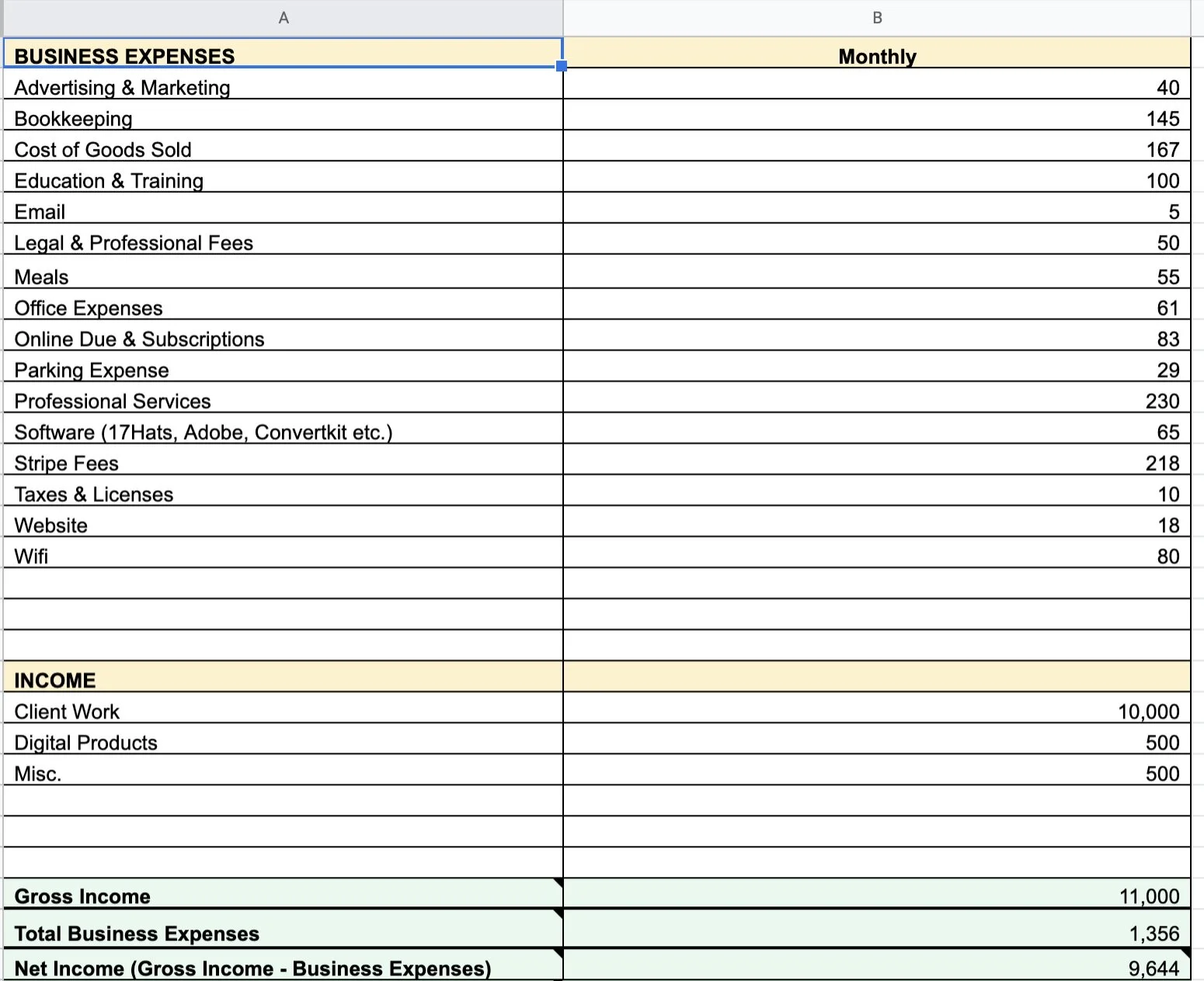
An example of monthly expenses
How to Apply this IRL?
Depending on what phase you’re in of your design career (Newbie, Freelancer, Creative Expert) will determine if you charge hourly or per project. Let’s go over how to figure out how to charge for both.
Hourly Pricing
First, you need to figure out the number of hours you’ll be working per week (x 4 for monthly). When charging hourly you need to take into account hours that are not billable also for example your marketing, emailing back and forth with clients, admin work, etc. That means if you’re working full time for yourself, you're not going to be billing 40 hours per week. From personal experience I’d say I max out at 20 hours of client work per week, that’s 80 hours per month. To calculate your hourly rate you divide your monthly revenue from above by the hours you will bill each month.
Needed Monthly Revenue / Hours Billed Per Month
(eg: $10,000 / 80hrs = $125 per hour)
Flat Rate Pricing
Flat rate pricing works great if you're offering similar scope and deliverables to clients over and over again, this makes it easy to refine your process and understand how many clients you want to be working with per month. For example, if you are a web designer you may not be able to take on more than one or two clients per month without feeling overwhelmed and delivering on time. To calculate your per-project rate you divide your monthly revenue from above by the number of clients you plan to work with each month.
Needed Monthly Revenue / Number of Clients Per Month
(eg: $10,000 / 2 clients = $5,000 per project)
How to use Value Based Pricing
Once you begin to gain more experience, become a seasoned freelancer and step into the role of Creative Expert you can begin to explore value-based pricing. Rather than pricing the project off of a list of deliverables, you focus on the value of the client’s goal they’d like to achieve.
This is where Value-Based Pricing can become tricky for many designers. How do you define the value of a goal? Short answer: by asking a lot of questions.
Before giving any price to the client you need to have a face-to-face meeting or video call. The client usually comes into the discovery session with an idea of how much they’re willing to spend on the project and it’s your duty to figure the amount by having an open conversation with the client.
Here are some questions you can ask in order to understand the client’s problem.
Can you tell me about your business and what you need for this project?
Can you tell me more about the service/product you’re offering?
What’s the price point for this service/product?
What is your goal for this project?
Why will [YOUR SERVICE] help you achieve your goal?
Why are you ready to invest in your goal now?
How will we measure the success of this goal?
(This is what you’ll base the price off)
By asking a lot of questions, two things will begin to happen. First, the client will start to see you as the creative expert and understand the value that you’re bringing to the table. Second, you can diagnose the client's problem so that you can provide them with a solution (value!).
Focus on solutions, not deliverables
Rather than focusing on the scope or list deliverables for a project you need to become a problem solver. Because every client's problem is unique, begin with understanding the client's problem. Determining the client's pain points and goals gives you an understanding of what they're hoping to achieve and allows you to diagnose the problem rather than the client self-diagnosing and telling you what they need.
Here are some examples of common problems a client might self-diagnose and solutions you can offer.
Problem: “I need a logo”
Solution: They’re in need of a brand identity that will elevate their online presence so they can begin to build trust and brand recognition.
Problem: “I need a place where clients can book my services online”
Solution: They need a website that is on brand and user friendly so that they can attract more clients to their business and allow customers to book services online.
Problem: “I need to sell my product online”.
Solution: They need an e-commerce website that is user-friendly so that they can convert visitors to customers.

How do you come up with a number?
After diagnosing their problem and understanding the goal they hope to achieve you can begin to explore the price for the project. Every client is going to have a unique problem therefore the value of the solution will be different also.
Depending on the measure of success for the client’s problem (see question 7 above) the end goal will be tangible or intangible. Intangible goals might be a brand identity that brings the client brand awareness, this is harder to measure. A tangible goal might be a sales page that allows the client to launch a course that makes them $60k.
After using Value-Based Pricing for two years I aim for between 5-10% of the clients’ measurable goal. Let’s say you’re creating a sales page for a coach and their goal is $60k during the launch. Investing $3k (5%) in order to reach that goal seems reasonable, right?
Maybe that’s too low, what about $6k (10%)?
Part of using Value-Based Pricing with your graphic design clients is finding the price that is right for their business and goal which is while the price will change for each client.
Want to learn more about Value-Based Pricing for graphic designers? Check out the resources below:
Chris Do
https://www.youtube.com/watch?v=ivKnj9ffcmE
Morgan Rapp